Waking with a tight lower back, a stiff neck, or a numb shoulder is not always a sign that you need to sleep longer. It can mean your body spent eight hours working against its own alignment. This guide to sleep posture will help you identify a position that supports your spine, reduces pressure on sensitive joints, and helps your mattress do the job it was designed to do.
There is no single “perfect” position for every sleeper. Your body shape, pain points, mattress firmness, pillow height, and even whether you share the bed all matter. The goal is simpler: keep your ears, shoulders, hips, and knees in a position that allows your spine to rest in its natural curve, without creating excessive pressure or twisting.
Why sleep posture affects how you feel
Your muscles are meant to recover while you sleep. When your neck is bent too far forward, your hips sink too deeply, or your shoulder carries too much load, those muscles stay on duty. That can leave you feeling less refreshed even after a full night in bed.
A supportive sleep setup does three things at once. It cushions prominent areas such as the shoulders and hips, holds the heavier parts of the body from dropping too far, and keeps heat from building up around you. This is why sleep posture and mattress performance cannot be separated. A position that works well on a pressure-relieving, responsive hybrid surface may feel very different on an old mattress with deep sagging or rigid springs.
If pain is severe, persistent, follows an injury, or comes with tingling, weakness, or loss of sensation, speak with a qualified healthcare professional. Sleep adjustments can improve comfort, but they are not a substitute for medical assessment.
A guide to sleep posture by sleeping position
Back sleeping: balanced support for the spine
Back sleeping is often the easiest position for maintaining a neutral spine because your weight is distributed across a broad surface. Your head, upper back, pelvis, and heels all receive support, rather than placing most of the load on one shoulder or hip.
The trade-off is that back sleepers need the right balance of contouring and lift. If the mattress is too soft, the hips can sink below the rib cage and flatten the lower back. If it is too firm, the lower back may feel unsupported and the upper back may develop pressure points. A medium to medium-firm hybrid mattress often works well because pocketed coils provide stable support while comfort layers cushion the body.
Use a pillow that fills the space beneath your neck without pushing your chin toward your chest. A thin pillow beneath the knees can also reduce strain by slightly easing the pull on the lower back. If you wake with neck soreness, do not automatically add more pillows. A taller stack commonly makes the problem worse.
Back sleeping may not be the best choice for people whose snoring becomes noticeably worse when lying face up. In that case, shifting to a supported side position may be more comfortable.
Side sleeping: pressure relief with better alignment
Side sleeping is common, especially among people who prefer to feel cocooned and couples looking for a comfortable, low-disturbance position. It can be excellent for alignment, but only if the shoulder and hip are allowed to sink in just enough while the waist remains supported.
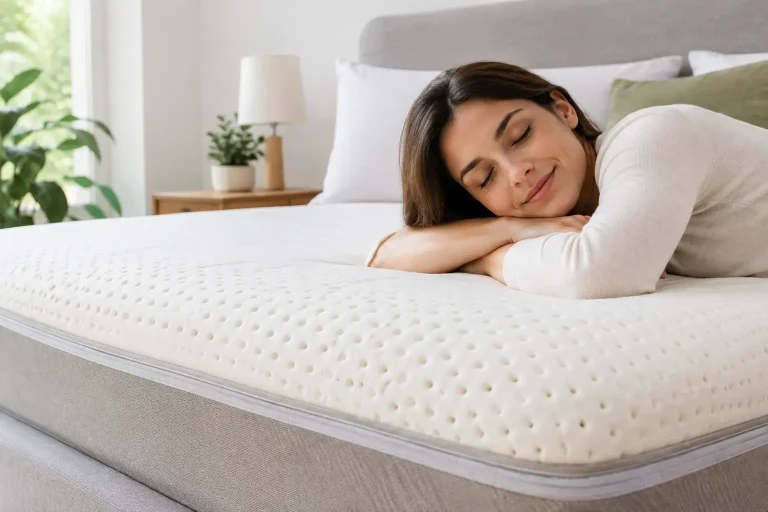
The main challenge is pressure. Your shoulder carries significant weight, and a mattress that is too firm can compress the joint, create arm numbness, and make you toss and turn. A surface with responsive latex or adaptive foam can ease pressure without allowing your midsection to collapse. Beneath those comfort layers, individually pocketed springs help keep your body supported and reduce movement transfer when your partner changes position.
Your pillow is especially important when sleeping on your side. It should be high enough to keep your head level with your spine, not tilted down toward the mattress or lifted toward the ceiling. Many side sleepers also benefit from a pillow between the knees. It helps keep the top hip from rolling forward, which can reduce twisting through the pelvis and lower back.
If one shoulder is consistently painful, try changing sides before replacing your entire sleep setup. If both shoulders ache, inspect the mattress for excessive firmness, sagging, or a lack of pressure relief.
Stomach sleeping: the position that needs the most adjustment
Stomach sleeping can feel familiar and comforting, but it is generally the most difficult posture to support well. Turning your head to one side for hours can strain the neck, while the pelvis may dip into the mattress and increase stress through the lower back.
You do not have to force yourself to change overnight. Start by reducing the strain. Choose a very thin pillow, or try sleeping without one if that feels comfortable for your neck. Place a thin pillow under the pelvis and lower abdomen to limit excessive arching in the lower back. A firmer, stable mattress surface is usually more suitable than a deeply plush one for stomach sleepers.
If you are trying to move away from stomach sleeping, begin by falling asleep on your side with a pillow hugged in front of your chest and another between your knees. This can create the sense of security many stomach sleepers are seeking while placing less rotation on the neck.
Match your pillow to your posture
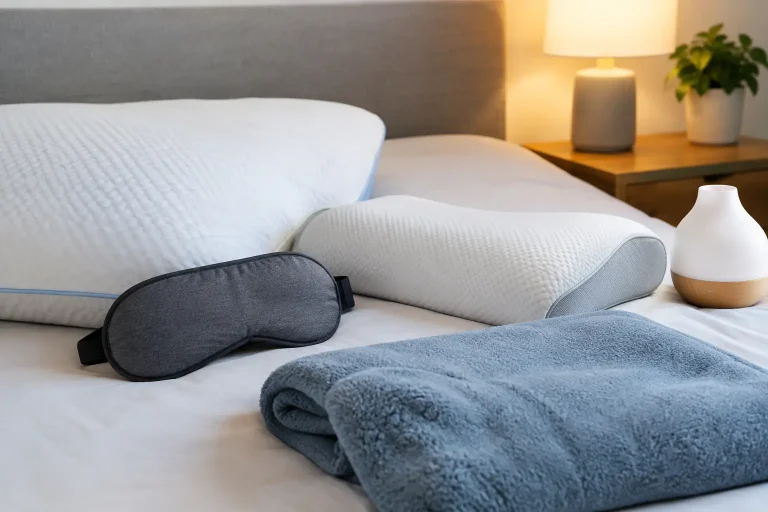
A mattress supports your body from below. A pillow completes the system by supporting the neck. Even a premium mattress cannot compensate for a pillow that is too high, too flat, or packed down beyond recovery.
As a general rule, back sleepers need a medium-loft pillow that supports the neck’s natural curve. Side sleepers usually need a higher, firmer pillow to fill the distance between the ear and shoulder. Stomach sleepers need the lowest loft possible. Combination sleepers should look for a responsive pillow that can compress and rebound as they move.
Pay attention to the first few minutes after waking. If you feel the urge to stretch your neck aggressively, if your jaw feels tense, or if your shoulder is pressed upward toward your ear, your pillow height may be working against your posture.
How to tell if your mattress is supporting your posture
A mattress should feel comfortable, but comfort alone is not the full test. The more useful question is whether you can hold a relaxed, neutral position through the night without waking to shift away from pain or heat.
Look for these practical signals:
- Your lower back feels supported rather than hollow or forced flat.
- Your shoulders and hips are cushioned without feeling trapped in the surface.
- You can change positions without fighting deep sinkage.
- Your partner’s movements do not repeatedly wake you.
- You wake with less stiffness than you had before going to bed.
A visible body impression, a sagging center, or a feeling that you are rolling toward one spot are signs that your mattress may no longer be providing even support. For couples, uneven wear can also create different comfort zones on each side of the bed, making posture harder to maintain.
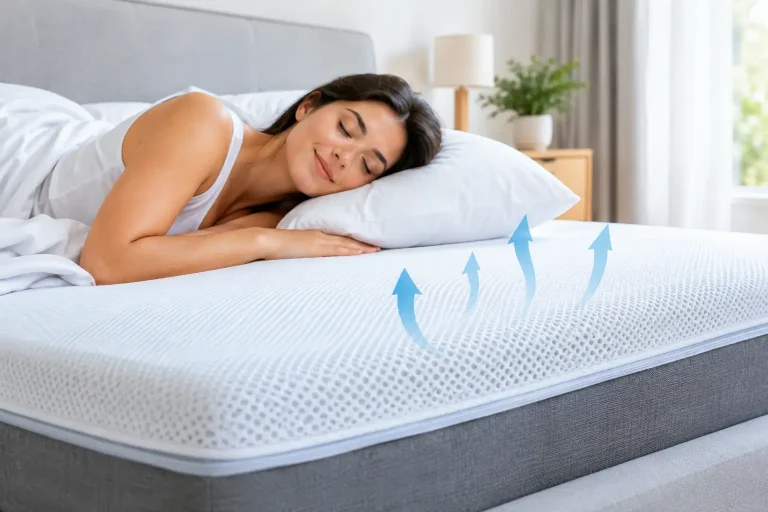
A well-designed hybrid mattress addresses several posture needs at once. Responsive comfort layers can relieve pressure around the shoulders and hips. A structured coil system can support spinal alignment and limit motion transfer. Breathable materials can help prevent overheating, which matters because people naturally change position more often when they are uncomfortably warm. Azure Mattress builds its sleep systems around these connected outcomes: comfort, spine and joint support, and cooler sleep.
Make changes one at a time
Do not replace your mattress, pillow, and sleep position all in the same week. You will not know what made the difference, and your body may need time to adapt. Begin with the simplest correction: pillow height, a pillow between the knees, or a thin cushion under the knees or pelvis.
Give each adjustment several nights unless it causes clear discomfort. Your posture during sleep is a habit, and habits rarely change in one evening. If you still wake with aches after improving your pillow setup, then assess whether the mattress is providing enough pressure relief, stable support, and temperature control for your preferred position.
The best sleep posture is the one that lets your body become quiet. When your neck is level, your hips are supported, your joints are cushioned, and your bed stays comfortably cool, restful sleep stops feeling like something you have to chase.