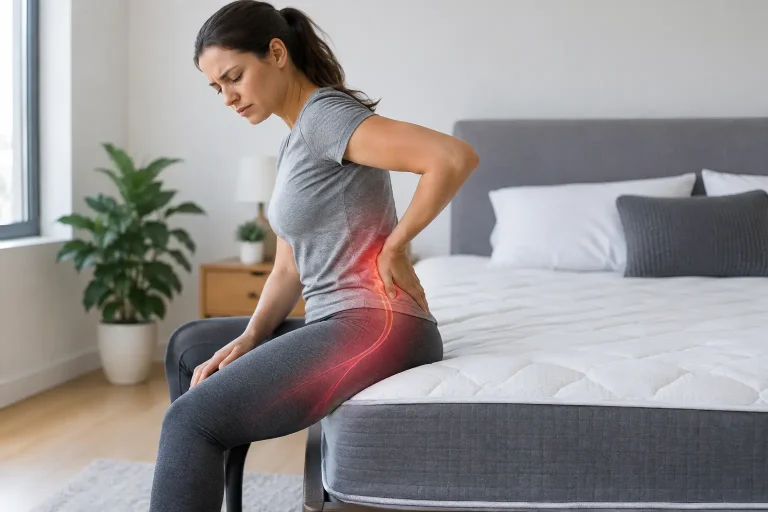
Back pain rarely shows up because you picked the “wrong” firmness on a website quiz. More often, it comes from a mattress that lets your hips sink just a little too far, pushes too hard on your shoulders, or traps heat until you spend the night shifting positions. That constant micro-adjusting is what turns a full night in bed into a morning that feels like you never recovered.
If you’re deciding between latex and memory foam, you’re already asking the right question. Both can reduce pressure and improve comfort, but they do it in very different ways. And when the goal is less pain and better spinal alignment, those differences matter.
Latex vs memory foam for back pain: what actually matters
A mattress doesn’t “fix” a back. What it can do is stop aggravating the problem by supporting your spine in a neutral position, distributing weight to reduce pressure points, and keeping you stable enough that you’re not bracing all night.
When people compare materials, they often focus on feel: bouncy versus hugging. For back pain, the better lens is performance: how consistently the mattress holds your pelvis and ribcage in line, how it handles your body’s curves, and whether it stays comfortable across a full sleep cycle.
Latex and memory foam are both used in pain-relief designs because they’re better at pressure distribution than old-school connected coils or thin polyfoam. The trade-off is how they respond under load, how they handle heat, and how stable they feel when you change position.
How latex supports your back (and why it feels different)
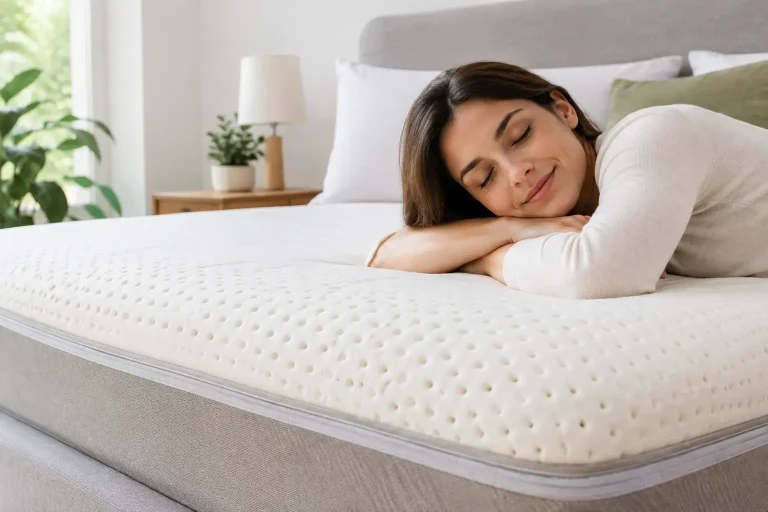
Latex is naturally elastic. When you lie down, it compresses and pushes back more quickly than memory foam. That “pushback” is the key word for many back-pain sleepers.
For side sleepers, latex can cushion shoulders and hips while still keeping the midsection from collapsing. For back sleepers, it tends to support the lumbar curve without creating that stuck-in-a-dent feeling. For combination sleepers, the faster response makes it easier to roll from side to back without fighting the surface.
Latex also tends to distribute pressure in a more buoyant, lifted way. It doesn’t need as much depth to feel supportive, which is one reason latex layers are often paired with a structured support core like pocketed coils. The comfort comes from conforming, but the alignment comes from the mattress resisting excessive sink.
The main “it depends” factor: if you crave a deep, slow-melting cradle, latex can feel too springy. People with very sharp pressure sensitivity sometimes prefer the way memory foam compresses and holds a shape under the body.
How memory foam relieves pressure (and where it can go wrong)
Memory foam is viscoelastic. It softens with heat and pressure, then slowly forms around you. That contouring can be excellent for pressure points, especially if you wake up with aching shoulders or hip pain from side sleeping.
For some back-pain sleepers, though, the same contouring can create a problem: alignment drift. If the foam is too soft for your weight or too thick without a strong support system underneath, your hips can sink deeper than your upper body. That can tilt the pelvis and strain the lower back.
Memory foam also has a more pronounced “impression” as you sleep. If you spend hours in one position, the foam can relax further and allow additional sink. That’s not automatically bad, but if you already deal with morning stiffness, it’s worth paying attention to how supported you feel after several hours, not just the first five minutes.
The other common issue is heat. Traditional memory foam tends to trap warmth because it conforms closely and limits airflow at the surface. Many modern designs address this with cooling gel infusions, open-cell structures, and breathable covers, but the baseline behavior is still more heat-retentive than latex.
Alignment first: which one keeps your spine straighter?
Back pain relief usually starts with preventing sag in the heaviest zones: hips and midsection. That’s why the support core matters as much as the comfort layer.
Latex, by nature, is better at “holding you up” while still cushioning. That often makes it easier to maintain neutral alignment, especially for back sleepers and combination sleepers. Memory foam can do alignment well too, but it’s more sensitive to density, thickness, and what’s underneath it. A high-quality, higher-density foam over a stable core can be excellent. A softer, lower-density foam over a weak base is where people get that hammock effect.
If you’re heavier through the hips or carry more weight around the midsection, latex tends to be the safer bet for consistent support. If you’re lighter and primarily need pressure relief at the shoulders and hips, memory foam can feel more immediately soothing, as long as it’s paired with strong underlying support.
Pressure relief: the real reason many side sleepers choose foam
Side sleeping is the pressure-point position. Your shoulder and hip take the brunt of the load, and if the surface doesn’t give enough, you wake up numb or sore. Memory foam’s slow contouring can shine here because it spreads pressure over a wider area and reduces peak force at bony points.
Latex relieves pressure too, but it does it with a more responsive contour. Many side sleepers love that balanced feel: cushioned, but not swallowed. If you’ve ever tried memory foam and felt like your shoulder sank in while your neck and upper back didn’t know where to go, latex may feel more “even.”
A practical way to choose: if your pain is mostly pressure-driven (aching shoulders, sore hips), memory foam often feels more dramatic in the short term. If your pain is mostly alignment-driven (lower-back tightness, soreness that builds overnight), latex often feels more stable over a full night.
Temperature regulation: back pain gets worse when sleep breaks
When you overheat, you wake up. When you wake up, you toss. When you toss, your muscles don’t fully relax – and back pain tends to feel louder in the morning.
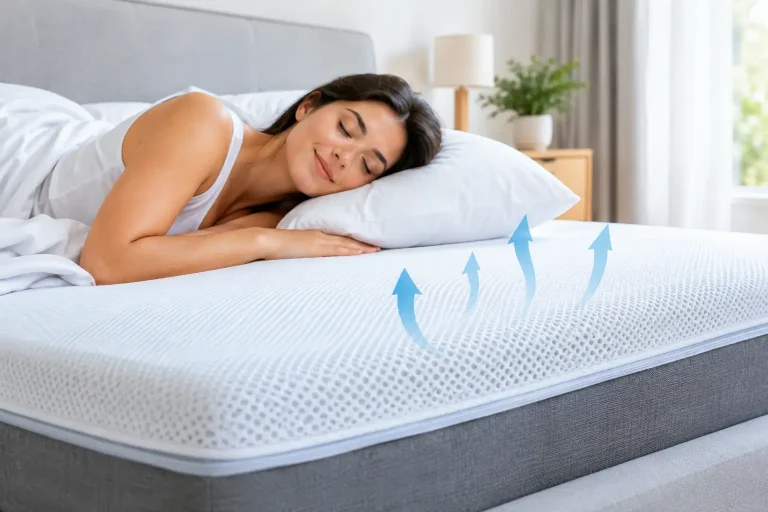
Latex is typically the cooler option because it’s more breathable and doesn’t envelop the body as tightly. It also pairs well with airflow-focused designs.
Memory foam can sleep cool, but it depends heavily on the build: cooling gel foams, breathable covers, and a support system that allows air to move. If you’re a hot sleeper and you’ve already had bad experiences with foam, you’ll want a design that treats cooling as a core outcome, not a marketing add-on.
Motion isolation and “zero disturbance” for couples
If your partner’s movement wakes you, your back pain gets a second hit: disrupted sleep reduces recovery and increases muscle tension.
Memory foam naturally isolates motion well because it absorbs movement rather than bouncing it across the surface. Latex is more responsive, so it can transfer more movement than memory foam when used alone.
This is where hybrid engineering matters. Pairing comfort layers with individually pocketed springs can create that stable, quiet feel while keeping the mattress supportive. Pocketed coils compress independently, so you’re not pulled around by someone else turning over. With the right build, you can get the pressure relief you want and the “zero disturbance” behavior couples need.
Durability: which stays supportive year after year?
For back pain, durability is not a nice-to-have. If a mattress loses support, your alignment changes and the pain returns.
Latex has a strong reputation for maintaining its resilience over time. It tends to resist permanent body impressions better than many foams, especially lower-density memory foams.
Memory foam durability varies widely. Higher-density foams generally hold up better, while softer, lower-density foams can break down faster and form impressions. That doesn’t mean memory foam is “bad,” but it does mean you should treat it like a performance material: specifications and construction matter.
If you’ve ever had a foam mattress that felt great for six months and then suddenly didn’t, you already understand why durability is part of pain relief.
So which should you choose for back pain?
Choose latex if you want a more lifted feel with steady support, you change positions often, you sleep hot, or your discomfort feels like an alignment problem that builds overnight. Latex tends to deliver a cleaner combination of pressure relief and spine support without as much risk of sinking too far.
Choose memory foam if you want the deepest contouring for pressure points, you prefer a more “hugged” feel, and you sleep best when the surface absorbs movement. Just be stricter about support underneath the foam and about cooling features if you run warm.
If you feel stuck between the two, the most reliable answer for many back-pain sleepers is not choosing one material forever. It’s choosing a design that uses each material where it performs best. A well-built hybrid can combine a responsive, pressure-relieving top with a structured support system underneath, delivering comfort, spine and joint support, and overheating control as a complete sleep system.
That’s also why many shoppers land on engineered hybrids like those at Azure Mattress, where material choices are framed around measurable outcomes: alignment, pressure distribution, and temperature regulation – not just a “soft versus firm” label.
A quick self-check before you commit
When you test any mattress, give it a few minutes in your real sleep position and ask two questions. Do you feel your hips sinking lower than your ribcage? And can you fully relax your lower back and shoulders without bracing? If the answer is “yes” to the first or “no” to the second, the material may be comfortable, but the build may not be supportive enough for your body.
The best mattress for back pain is the one that makes your body feel quiet at night and capable in the morning – because the goal isn’t a dramatic first impression. It’s waking up and realizing you didn’t think about your back at all.