You usually feel a bad mattress before you can describe it. You wake up stiff across the lower back, shift around at 3 a.m., and start the day already compensating for a night that should have helped you recover. If you’re wondering how to choose mattress firmness for back pain, the right answer is not simply soft or firm. It’s support first, pressure relief second, and the right balance between the two for your body and sleep position.
A mattress that feels comfortable for five minutes in a showroom can still leave your spine unsupported for eight hours. That’s why firmness should never be judged as a comfort preference alone. For people dealing with back pain, firmness is really about alignment. The goal is to keep your spine in a more neutral position while reducing pressure at the shoulders, hips, and lower back.
What mattress firmness actually means
Firmness describes how a mattress feels when you lie down on it. It is not the same thing as support, even though shoppers often use those terms interchangeably. A mattress can feel plush on top and still be highly supportive underneath if the deeper layers keep your body from sinking too far. On the other hand, a mattress can feel hard at the surface and still fail to support proper alignment if it creates pressure points and forces your body into awkward positions.
This is where many back pain decisions go wrong. People assume a firmer mattress is always better because it sounds more orthopedic. In reality, a mattress that is too firm can push up against the hips and shoulders, especially for side sleepers, while leaving the lower back without enough contouring. A mattress that is too soft creates the opposite problem by letting the hips dip too deeply and pulling the spine out of line.
For most adults with back pain, the most reliable starting point is medium-firm. That range tends to offer enough pushback for spinal support without sacrificing pressure relief. But medium-firm is still a range, not a guarantee. Your body weight, sleep position, and the type of mattress construction all matter.
How to choose mattress firmness for back pain based on sleep position
Sleep position has a direct impact on how your weight is distributed across the mattress, which changes what “right firmness” looks like.
Side sleepers
Side sleepers usually need more pressure relief than back or stomach sleepers. Most body weight falls into the shoulders and hips, so a mattress that is too firm can create compression and pain at those contact points. At the same time, it still needs enough support underneath to keep the waist and lower back from collapsing inward.
For many side sleepers with back pain, medium to medium-firm works best. A hybrid design is often especially effective because it can combine a pressure-relieving comfort layer with a more stable coil system below. That gives you cushioning where you need it without the “stuck” feeling that some all-foam mattresses create.
Back sleepers
Back sleepers usually benefit from a slightly firmer feel because the body needs even support along the entire spine. If the mattress is too soft, the pelvis can sink lower than the chest and legs, putting strain on the lumbar area. If it is too firm, it may not fill in the natural curve of the lower back.
For back sleepers, medium-firm to firm is often the strongest range. The best option will support the lumbar region while still allowing a small amount of contouring. You should feel held up, not flattened out.
Stomach sleepers
Stomach sleeping is generally the hardest position on the lower back because it tends to exaggerate the spine’s natural curve. If you sleep this way, firmness becomes even more important. A mattress that is too soft allows the midsection to dip, which can increase lower back tension by morning.
Most stomach sleepers need a firmer surface, often firm or medium-firm, to keep the hips elevated and the spine more level. If you also have shoulder discomfort, the trade-off gets more nuanced. You may need supportive firmness overall, but with enough surface cushioning to reduce pressure.
Combination sleepers
If you shift between side, back, and stomach sleeping, avoid extremes. Very soft and very firm models can feel fine in one position and punishing in another. Medium-firm is usually the safest choice because it adapts better across positions and reduces the chance of major misalignment during the night.
Your body weight changes how firmness feels
The same mattress can feel soft to one person and firm to another. Body weight plays a big role in that difference.
Lighter sleepers often do not sink as deeply into the comfort layers, so a firm mattress may feel harder than intended and create pressure points. Heavier sleepers tend to compress the upper layers more, so a mattress that feels balanced for a lighter person may feel too soft and unsupportive.
As a general rule, lighter sleepers may do better with soft to medium-firm depending on position, average-weight sleepers often land in the medium to medium-firm range, and heavier sleepers usually need medium-firm to firm with strong underlying support. This is one reason hybrid construction can be so effective for back pain. Responsive foams or latex can cushion the surface while pocketed coils maintain better lift and spinal support underneath.
Why construction matters as much as firmness
When people focus only on firmness labels, they miss what actually creates the sleep experience. Two mattresses both labeled medium-firm can perform very differently.
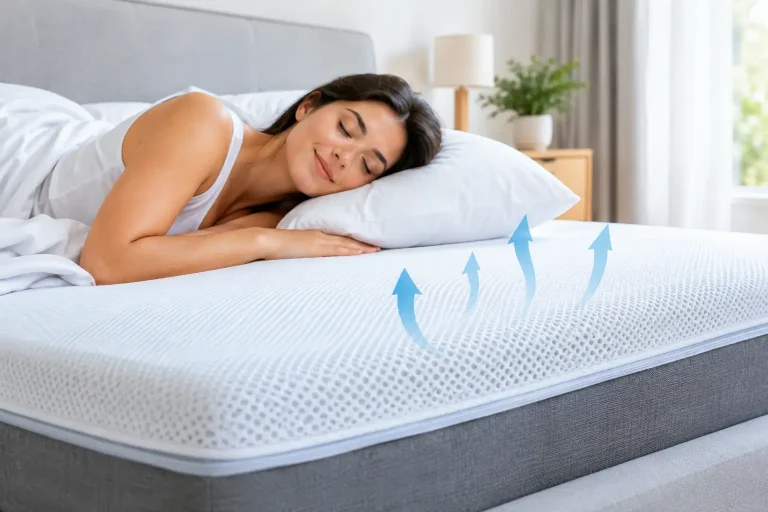
A quality hybrid mattress typically has a more complete support story for back pain. The comfort layers can relieve pressure around the shoulders and hips, while individually pocketed coils help keep the spine more evenly supported. That structure also reduces excessive sink, improves airflow, and limits motion transfer if you share the bed.
Latex can be especially useful if you want pressure relief without a deep, slow-sinking feel. It responds quickly and helps keep the body lifted. Cooling gel foams can add contouring without trapping as much heat as traditional dense foams. Pocketed springs add targeted support and make it easier for the mattress to respond to heavier areas like the hips.
This is why a medium-firm hybrid often works so well for adults managing back pain, partner disturbance, and overheating at the same time. It solves multiple sleep problems in one design rather than forcing a trade-off.
Signs your mattress firmness is wrong
Your body usually gives clear feedback. If you wake up with lower back tightness that improves once you start moving, your mattress may be too soft or lacking support. If you wake up with sore shoulders, hip pressure, or numbness in your arms, your mattress may be too firm at the surface.
If you sleep better in a hotel bed than your own, that is also useful data. Pay attention to whether that bed felt more supportive, more cushioned, or both. If you constantly roll toward the center of the bed, or notice a visible dip where you sleep, the issue may be wear rather than original firmness.
Persistent pain is never something to “push through” because a mattress needs breaking in. Some adjustment is normal, but ongoing misalignment is not.
How to test the right firmness without overcomplicating it
Start with your current mattress. Ask what is actually going wrong. Are your hips sinking? Are your shoulders jammed? Are you waking up hot and restless, which makes pain feel worse? Getting specific helps you avoid replacing one problem with another.
Next, match firmness to your primary sleep position and body type rather than choosing by feel alone. If you have lower back pain and sleep on your back, prioritize stable support with moderate contouring. If you have upper and lower back tension and sleep on your side, make sure there is enough cushioning for the shoulders and hips.
If you share a bed, motion isolation matters too. Back pain often feels worse when sleep is fragmented. A mattress that reduces partner movement can improve recovery even if firmness itself is technically correct. The same goes for temperature control. Overheating leads to more tossing and turning, and that constant repositioning can aggravate sore joints and muscles.
A trial period is valuable because real testing happens over nights, not minutes. Brands like Azure Mattress make this easier with online ordering, free shipping and returns, and a design approach centered on spine support, pressure relief, and cooler sleep. That combination matters when your goal is not just comfort, but less pain and better recovery.
If you are between two firmness options
When in doubt, most people with back pain should lean slightly firmer rather than noticeably softer, but only if the mattress still has enough comfort layering to relieve pressure. Too soft tends to create larger alignment problems over time. Too firm can sometimes be adjusted with a topper, while a mattress that lets your hips sag is harder to fix.
That said, “firmer is safer” is not a universal rule. If you are a lightweight side sleeper with back pain, going too firm can make your symptoms worse, not better. The right choice is the one that keeps your spine steadier and your pressure points calmer through a full night of sleep.
Choosing mattress firmness for back pain is less about chasing a firmness number and more about choosing a design that keeps your body aligned, cushioned, cool, and undisturbed. When those elements work together, sleep stops feeling like something you endure and starts doing what it should – helping your body heal.